This blog is the first in a series of examining thought-provoking historical figures and parallel developments in quantum technologies.
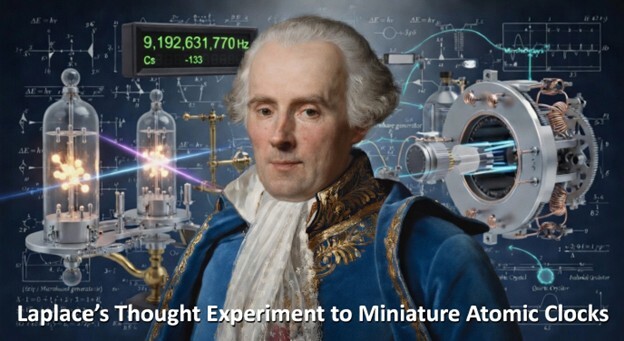
In the early nineteenth century, the French mathematician and astronomer, Pierre-Simon Laplace, proposed a famous thought experiment. He hypothesized that if we could know the exact position and velocity of every single particle in the universe at one moment in time, together with all the laws of nature, then we could calculate the past and the future of the universe with perfect certainty. It was the basis of what became known as “mechanistic determinism”.
However, given that the universe contains roughly 1080 particles, realizing such a feat would require building an intelligence so vast that it would demand more resources than the universe itself could furnish.
Yet, even if such fantastical abilities existed, the laws of nature — and Heisenberg’s uncertainty principle in particular — tell us it is fundamentally impossible to know both the exact position and momentum of any particle at the same time. This limitation is famously demonstrated in his gamma-ray microscope thought experiment. Put simply, the moment you establish a particles momentum, you lose sight of its position, and the moment you establish a particles position, you lose sight of its momentum. That acknowledged, there remains an intriguing kernel of truth in Laplace’s idea as we move ahead a couple of centuries and consider miniature atomic clocks.
These devices have successfully exploited elements of Laplace’s theory at a more modest scale, yet to enormous effect. To give one practical and very current example. Based on the extremely precise timing of these quantum devices, drones and other guided systems can maintain unbreakable and tight synchronization, even when completely cut off from GPS. Such control is critical in an age where militaries have become increasingly adroit — and more devastatingly effective — in electronic warfare.
To understand how these clocks work, we need to examine four core technical elements: the physical packaging, the light source, atomic resonance, and frequency output stabilization.
In any schematic, the giveaway that you are looking at an atomic clock is the presence of a tiny glass or silicon vapor cell containing rubidium or cesium atoms, along with a heater to ensure that the atoms remain in vapor form. The assembly is then appropriately shielded to protect from harmful, external magnetic fields.
The first critical element is the light source — typically a VCSEL (vertical-cavity surface-emitting laser). Light is modulated and directed through the vapor cell, producing two closely related optical frequencies. These are derived from the difference between the electron and nucleus spin. This creates a state of quantum superposition — one atom effectively exists in two energy states at once. This offset between frequencies never changes. It is this inviolability that lies at the heart of the device and the essence of its utility; exact geo-spatial placement and timing.
Electronics make tiny adjustments to keep the clock locked into this difference. Any drift from exact resonance reduces the quality of this dark state, causing a small decrease in the amount of light transmitted through the cell. A circuit analyzes these variances, then applies an immediate correction—nudging back to the exact resonance to ensure that near-perfect superposition—the coherent dark state—remains. This constant fine-tuning (think adaptive cruise control) takes place many times a second and ensures years of stability.
The same underlying principle — quantum superposition creating controlled interference — is also exploited in the pursuit of quantum computing. Regarding the latter, superposition allows qubits to exist in multiple states simultaneously, enabling vast parallel exploration of possibilities for certain calculations. In both miniature atomic clocks and quantum computing research, we see the same powerful idea at work: by precisely controlling the quantum states of an individual or small number of atoms, we achieve a level of predictability and stability that Laplace conjectured—and probably on a more impressive scale than he ever anticipated.
At Palomar’s Advanced Solutions Division, we have been supporting the development of these quantum technologies for many years, drawing on decades of expertise in precision photonics and other forms of microelectronic packaging. Much of our early insights proved prescient. In 2021 we published a three-part series titled “Packaging Technologies Meet Quantum Opportunities,” which explored how advanced packaging would enable the commercialization of quantum devices, including challenges in scaling vapor cells, VCSEL integration, and hermetic assemblies. Five years later some of these challenges remain acute. As problems are resolved, we cannot but reflect on the practical echo they represent to Laplace’s vision. Not the cosmic certainty of an infinite intelligence, but extraordinary stability and predictability emanating from controlled quantum states, all from a device the size of a US Quarter. Building on this experience, we remain ready to support companies working on these technologies with prototyping, process development, and scalable manufacturing solutions. You can reach our General Manager here.
Keep an eye out for the second installment in this series: “Heisenberg Revisited: Quantum Error Correction and Emerging Quantum Networks.”
----
Dr. Anthony O'Sullivan
Palomar Technologies
Senior Director of Strategic Marketing