In 1952 Niels Bohr commented to Werner Heisenberg that “If quantum mechanics has not profoundly shocked you, you haven’t understood it” (Heisenberg’s Physics and Beyond). What specific element of quantum madness Bohr had in mind, he does not say. The fact is there are many, and perhaps that is his point.
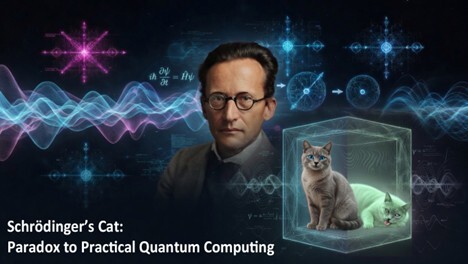
Seventeen years earlier, Erwin Schrödinger proposed a thought experiment to dramatize what he saw as one of quantum theory’s most mind-numbing observations. This flowed from the lab experiment in which an unobserved radioactive atom exists in superposition, meaning in both states at once — decayed and not decayed. It also exists in many places at once, but that is a story for another day. To convey this two-states-at-once idea, Schrödinger proposed the following:
A cat is sealed inside a steel chamber along with a tiny amount of radioactive substance, a Geiger counter, a hammer, and a small flask of poison. The radioactive atom has a 50 per cent chance of decaying in the next hour. If the atom decays, the Geiger counter detects it, triggers the hammer, smashes the flask, releases the poison, and the cat dies. If the atom does not decay, the cat lives. Before anyone opens the box and looks, the radioactive atom is in a superposition of two-states-at-once: “decayed” and “not decayed”. In other words, the cat is simultaneously alive and dead until the moment an observer opens the box and measures the system.
Quantum computing seeks to exploit this principle in the realm of performing certain calculations with literally mind-numbing, extraordinary power: a quantum computer with just 300 perfect qubits could explore more possibilities than there are atoms in the observable universe, somewhere in the region of 1090, that is 1 followed by 90 zeros.
Before we explore this potential in more detail, we need to better explain the actual mechanics and differing potentials at work by comparing the nature of the classical bit against the quantum qubit. This is perhaps best done using a coin analogy. When a coin is lying flat on a table, to the observer it is clearly either heads or tails — you never see both sides at once. That represents our classical bit. Now spin that same coin on its edge fast enough and it appears to be both heads and tails at the same time. This is analogous to superposition — the heart of quantum computing’s extraordinary power. Some numbers will help us to see what exactly this means.
One classical coin can only be in one state at a time, two coins give four possible combinations, and three coins give eight possible combinations. A classical computer must check each of these possibilities one after another. A quantum computer, however, puts the “coins” (qubits) into superposition so that all possibilities exist and are explored in parallel at the same moment. As a result, even a modest quantum computer with just 10 to 20 good qubits can explore millions of possibilities simultaneously — something no classical computer can efficiently match.
Figure 1 shows how, in their perfect state, a quantum computer would surpass the combined classical computing power of the entire planet using a surprisingly small number of qubits — roughly in the 50–300 range, depending on the task.
|
Figure 1. Classical and Quantum Compute Comparison. |
||
|
Qubits (Perfect) |
Simultaneous States |
Comparison to Global Classical Compute |
|
10 |
1024 |
Already strong on tiny, specialized tasks. |
|
30 |
1 billion |
Far beyond any single supercomputer. |
|
50-60 |
1 quadrillion |
Beyond practical simulation by all supercomputers combined for many quantum problems. |
|
100 |
1030 |
Vastly exceeds total global classical power for suitable algorithms. |
|
300 |
1090 |
More possibilities than atoms in the universe — untouchable by any classical system. |
To put this in context—a leading supercomputer today contains roughly 1016 to 1017 bits of memory. To match that number of simultaneous possibilities, a perfect quantum computer would need only 53 to 57 qubits. In other words, just fifty-something perfect qubits can explore a bigger solution space than the entire memory of the world’s most powerful classical supercomputers.
As if our heads were not spinning enough, things are about to get seriously weirder. The real magic happens when we combine superposition with entanglement. Imagine not one spinning coin, but many coins that are perfectly linked to one another. While they spin, they are not just exploring all possible combinations independently — they are so deeply connected that measuring one instantly fixes the state of all the others. Measuring one coin instantly determines the state of its entangled partners, no matter the distance. It could be on the other side of the known universe. This pairing of superposition and entanglement is what lets a quantum computer with a relatively small number of qubits explore and manipulate an astronomically large, interconnected solution space — something that is fundamentally impossible for any classical computer, no matter how many bits or how much power it has.
At this juncture the reader may conclude that instantaneous correlation seems to contradict Einstein’s theory of relativity “nothing travels faster than the speed of light”. However, while the correlation is indeed instantaneous, you cannot use entanglement to send usable information faster than light. The measurement outcomes are fundamentally random, and the only way to compare results (and confirm the correlation) is by sending a classical signal at or below the speed of light.
It is now 28 years since the birth of the world’s first experimental quantum computer. It took another 13 years to create the first commercial system, and it was not until 2019 that the first integrated universal commercial quantum computer was finally built. This timescale underscores just how difficult it is to turn the theory into reliable, practical technology.
This will be the topic of our fourth and final blog in this series.
----
Dr. Anthony O'Sullivan
Palomar Technologies
Senior Director of Strategic Marketing