
Next time you are online, reflect on the fact that the invisible pathways carrying that data are strands of glass so pure that light travels through them for dozens of kilometers with almost no loss. That ability is ultimately the legacy of a decidedly reckless boy who approached the physical world in a very different spirit from the figures we have met in our previous blogs.
Einstein, Parkinson and Cerf each seized early upon a single captivating idea and pursued it with energy and single-mindedness. Their intellectual origin was fixed in their teenage years; they spent the rest of their lives working out that original insight. Charles Kao’s journey was different. His was a story of never-ending curiosity.
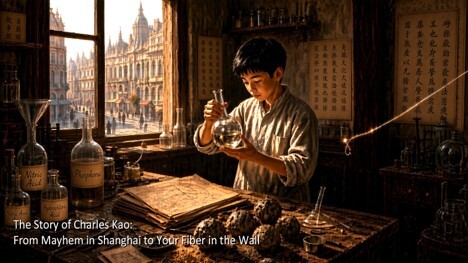
A Boyhood Laboratory in Shanghai
Growing up in Shanghai, with scientific magazines lying around the house, a family driver who could be sent out with a shopping list, and a strangely unsupervised household, he assembled a homemade laboratory from glass bottles, improvised equipment, and chemicals no twelve-year-old should ever possess — bottles of cyanide and concentrated acids among them. His parents, he said, “were not exactly understanding what we were trying to do.”
An early signature experiment was exploding mud balls. With a school friend he mixed an oxidizer with red phosphorus, packed the mixture into wet mud, and let it dry. These then became menacingly loud projectiles, frequently used to scare stray cats, dogs and the occasional human. He made chlorine “all over the place” and nearly gassed himself, stopping only when he felt dizzy. He made fireworks. He built a radio. He even boiled nitric acid until the bottle exploded and the contents ate clean through his brother’s trousers. That was the incident that ended the laboratory. His parents confiscated everything. “I wonder where they disposed of the stuff.”
As for family, Charles grew up in an environment that treated poetry, law, languages, philosophy, the classics, scholarship and science as the most natural of pursuits. His grandfather was a Confucian scholar and poet, his father a professor of law, his mother was trained in the classics, his cousin was an astronomer (a lunar crater is named after him), and his younger brother became a professor of civil engineering. Common to all was a rigorous independence of mind. In such a family, a curious boy was not an exception. He was almost inevitable.
That same exploratory temperament came to have a significant global impact. Had it been absent, practical optical fiber would almost certainly have been pushed years, perhaps decades, into the future. At a time when the leading laboratories were still focused on hollow metal waveguides or free-space optics, Kao alone kept pressing the awkward question, how pure can glass actually be made? His refusal to accept the prevailing limits redirected an entire field and turned a practical curiosity into the backbone of global communication.
From Hong Kong to London
When the Chinese civil war reached Shanghai in 1948, Kao’s family moved to Hong Kong and, in so doing, Charles — at least momentarily — left behind the rough and tumble of his earlier adolescent years to become a straight-A student. During this period his passion for chemistry yielded to an even greater interest in electrical engineering. As the subject was not taught at the University of Hong Kong, he left for England. It was here that he discovered another devotion — tennis. He later admitted he spent more time on the tennis court than with his books, leaving those A grades taking a bit of a dint. That did not deter him, however. After graduating he joined Standard Telephones and Cables (STC), then moved into its research arm at Harlow, Standard Telecommunication Laboratories (STL), simultaneously undertaking a doctorate at University College London (UCL).
Rethinking Glass at STL
In contrast to the freedom he felt at UCL, the STL experience, at least at first, proved somewhat constraining. While the team leader, Karbowiak, saw promise in optical waveguides, he gave little credence to Kao’s belief that ordinary glass could be cleaned to the point that losses were sufficiently reduced for long-distance use. Even while experiments were tightly limited, Kao’s mind remained free to prod, push, take apart and put back together again. He had little patience for a limit that had not been tested to exhaustion. When Karbowiak left for Australia he called the fiber project a “wild goose chase.” It is perhaps for that reason that once he became team leader, that temperament quickly found full expression.
Indeed, he immediately abandoned Karbowiak’s thin-film waveguide and changed direction. His experiments would no longer stop at optical physics. They would find focus in the chemistry of the material itself — what was in the glass, and whether it could be cleaned out. It was this step that led to the breakthrough. In retrospect it looks like the most obvious of questions: what in the glass was absorbing the light, and could those impurities be removed? Yet, at the time almost no one was asking it. That was Kao’s particular genius — not a single teenage vision, but the refusal to stop investigating a material until the real limit was established beyond dispute.
The Case for Purer Glass
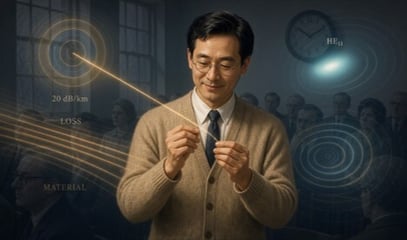
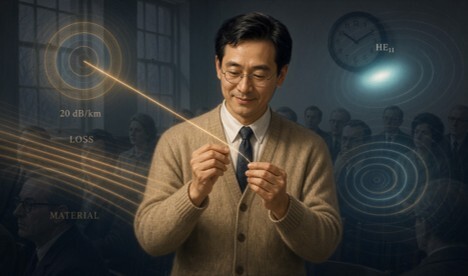 Charles Kao putting the case. A strand of glass with a slightly purer core, he argued, could guide light the way a pipe guides water. Losses are real, but they are not written into the laws of physics. Short laboratory fibers had already shown that light follows the glass. The obstacle is dirt. If the glass could be cleaned until only about 20 dB were lost per km, the fiber would work over much longer distances.
Eighteen months later he put the case before the Institution of Electrical Engineers in London. The paper, written with George Hockham, appeared in July 1966. Most of the world took no notice. Where it was noticed, the verdict was often Karbowiak’s, “a wild goose chase”. Kao’s mind did not change. He relentlessly insisted that the limit was dirt, not physics. He spent the following years repeating that sentence in Japan, Germany, the Netherlands and the United States, and to the glassmakers who would eventually prove it.
Years Ahead of the Consensus
At the same time his prodding acquired ever more diverse targets. He argued for single-mode fiber on long-distance routes when multimode still looked easier, and spoke of trans-oceanic cables when an undersea filament of glass still sounded like science fiction. In both contexts he was years ahead of the working consensus. The first confirmation of his 20 dB/km target came in 1970, when Corning drew a fiber that met the specification. The second — that the system itself would work — came in 1977, when telephone calls began to travel on glass. The “wild goose chase” became a communications revolution.
Yet the fiber in the wall is not a miracle. It is glass cleaned of its dirt — a task whose origin lay with a daring boy doing mad things in a makeshift laboratory. Einstein, Parkinson and Cerf each began with a single early vision. Kao was not merely a born experimenter. He was a born radical — in everything he went to the root. Theory was merely the servant in that journey. Even as a Nobel Laureate his question would always have been that of the child: “What will happen if … ?”
Common to our blogs have been the three themes of simplicity, initial resistance, and the eventual yielding of the wider community in the face of persistent evidence — at which point the new paradigm becomes too obvious even to the previously most orthodox. Optical fiber is that journey in silica. The limit was never the glass. It was the assumption that dirt had the last word.
----
Dr. Anthony O'Sullivan
Palomar Technologies
Senior Director of Strategic Marketing