How a Gold Ball Bond Is Formed
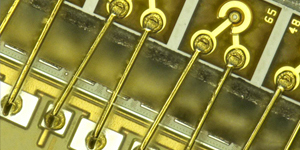
The first attachment point begins with forming a gold ball at the tip of the wire bond tool, called the capillary. The ball is pressed onto the heated assembly surface while the tool applies an application-specific amount of force and ultrasonic motion at 60–152 kHz.
Once the first bond is made, the wire is manipulated in a tightly controlled manner to form the right loop shape for the assembly's geometry. The second bond, often called the stitch, is then formed on the other surface by pressing down with the wire and using a clamp to tear the wire at the bond.
The Advantages and Flexibility of Gold Ball Bonding
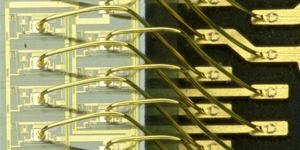
Gold ball bonding provides a highly electrically conductive interconnection within packages, nearly an order of magnitude greater than some solders. Gold wire also has high oxidation tolerance compared with other wire materials and is softer than most, which is essential for sensitive surfaces.
The process can be adapted to each assembly's needs. On sensitive materials, a gold ball can be placed on the second bonding area to create a stronger, "softer" bond that protects the component surface. In tight spaces, a single ball can serve as the starting point for two bonds, forming a "V"-shaped bond. Where a wire bond needs to be more robust, a ball can be placed on top of a stitch to form a security bond that increases the wire's stability and strength. The automated software on Palomar wire bond systems supports a wide range of these variations.
Resources for Gold Ball Bonding
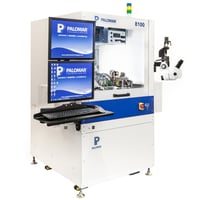
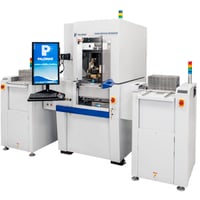
8100 Wire Bonder
9000 Wedge Bonder
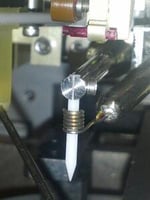
Gold Ball Wire Bonding with Heated Tool for Automotive Microelectronics