

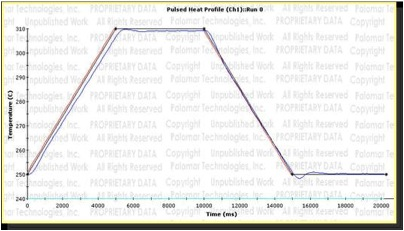
Hybrid components and high-power communication devices are classified as high-performance and high-capacity die attach applications. These types of  applications are well suited for automated eutectic process techniques. Eutectic die attach is a highly controlled die attach process. To achieve high yield, sophisticated heating and cooling mechanisms are employed. This includes software that heats and cools according to a very strict parameter line.
How Eutectic Reactions Work
The essence of a eutectic reaction is going from liquid to solid, bypassing the plastic state, using eutectic heating and cooling. Eutectic alloys for soldering are composed of Sn (tin), Pb (lead), Ag (silver) and Au (gold). When different metals are combined into alloys, a range of melting temperatures are created with varying proportions of each metal used: AuSi@363°C, AuSn@280°C.
The Eutectic Die Attach Cycle
During eutectic die attach, the substrate is heating to a temperature just below the solder's eutectic temperature. During the bond cycle, an incremental thermal energy is supplied to the solder layer to promote the solder melting process. Liquified solder then penetrates both bonding surfaces. The result is an intermetallic bond (also known as wetting) develops.
Pulsed Heat System
A high-accuracy pulsed heat system was specially designed in order to allow for a tightly controlled reflow, resulting in a stronger eutectic die bond without voiding. This system enables precision eutectic die attach through a customizable computer-controlled heating and cooling profile. The software provides a highly regulated temperature profile and data feedback throughout the process.

Meeting Accuracy and Throughput Requirements
Two important methods to meet accuracy and throughput requirements:
- Scrubbing – this method involves translating load force into frictional heat by cyclically moving the die back and forth, left to right, or horizontally.
- Temperature control – the Pulsed Heat System provides the additional heat needed for solder reflow. This allows for fast heating and cooling of the eutectic profile and active gas cooling.
For more resources on eutectic die bonding or the Pulsed Heat System, download these resources:
Automated Eutectic Die Attach eBook |
Pulsed Heat System Data Data Sheet  |
Improved Eutectic Die Attach with Pulsed Heat System eBook |
Process and Reliability Advantages of AuSn Eutectic Die Attach paper |
----
Janine Hueners
Marketing Specialist
Palomar Technologies, Inc.